


TANKA • 03
In our previous logs, we broke through and streamlined all data pipelines. A typical engineer would tell you the next step is Indexing—chunk the data, tag it, and store it in a vector database.
But I told my team: Stop. That’s just creating "digital corpses."
Traditional Index and Data have one fatal flaw: they are Subjectless. In a legacy database, a "sales record" is just an objective fact. It sits there in isolation, remaining exactly the same no matter who reads it.
But in an ANC (AI-Native Company), we build Memory. The fundamental difference is that memory must be tethered to a Subject to exist. Without the participation of a "Subject," data is nothing but a chaotic jumble of bytes.
Consider a single physical fact: "Everyone worked overtime last night."
For the Project Manager (Subject A), this memory is: "We’re back on track, and team morale is high."
For the New Employee (Subject B), this memory is: "The process is chaotic; I have no idea what we’re so busy with."
If Tanka simply indexed "working overtime" as an objective event, it would be a distortion. It would lose the most critical dimension: Who is experiencing it?
Therefore, we believe that "Indexing" is more than just tagging data—it’s about finding its belonging. We don't just record what happened; we record to whom it matters.
A’s Memory Cannot Become B’s Noise
Because memory is inherently subjective, the core engineering challenge in EverMemOS is not "storage," but "isolation and distillation."
"Full-scale" refers to the system; "Subjectivity" refers to the individual.
EverMind is omniscient, but as an individual, Employee A must never directly borrow Employee B's brain. This isn't just a matter of permissions; it’s a matter of cognitive logic. If A’s subjective experience were built upon B’s memories, A would suffer from a cognitive "split personality."
We aren't building a flat library; we are constructing a multi-dimensional, subject-centric Folded Universe.
The system must be able to answer: "Based on Subject A's perspective, what did that conversation just mean?"
When Data Begins to “Breathe”: The Technical Implementation of EverMemOS
To construct this “Subject-Centric Folded Universe,” we must re-engineer the cognitive architecture of AI from the ground up.
A truly AI-Native company does more than just capture data; it grants AI a human-like memory. This is not a simple, search-based “external plug-in hard drive,” but a “Digital Brain” capable of evolving over time, forging associations, and supporting complex decision-making.
Thus, we created EverMemOS—the core long-term memory system of Tanka.
1. The Problem: Why Context and Traditional RAG Fail the Soul of the AI-Native Enterprise
The current AI cognitive architecture is at a critical juncture, transitioning from “tool-based” to “agentic.” The sale of Manus illustrates that even amidst the AI Agent hype, no one has yet built a deep user-experience moat based on a data flywheel—as seen in the previous generation of search and recommendation systems. A single iteration of a foundational model or a competitor’s upgrade can easily wipe out an early mover’s advantage. The ultimate goal for all AI applications in the LLM era is to build a system that evolves autonomously based on user data.
Before diving into the architecture, we must clarify the exact problem a memory system is meant to solve in an AI-Native context.
Traditional AI applications typically handle “memory” using two strategies: providing all context to the LLM as a prompt, or using a RAG architecture to feed retrieval results into the LLM. Both approaches face the challenge of “Cognitive Dissonance,” a concept borrowed from brain science:
1.1 The Cognitive Limitations of “Stateless” Architectures
In an AI-Native context, relying solely on Context and RAG is essentially simulating “long-term intelligence” through an “open-book exam.” This Stateless architecture leads to several deep-seated flaws:
1. The Physical Bottleneck of Instant Attention: Expensive and Inefficient “RAM”
Traditional solutions attempt to simulate memory by blindly expanding the Context Window. This is merely increasing instantaneous RAM (analogous to human Working Memory), not creating persistent long-term memory.
The Paradox of Cost and Latency: Expanding context leads to an exponential increase in computational overhead. When the window overflows, the AI suffers from severe “amnesia” and logical fragmentation, losing the ability to track project evolution spanning months.
The Signal-to-Noise Contradiction: As background information piles up, the limitations of the attention mechanism often cause the model to fall into the “Lost in the Middle” trap, where instruction-following and information extraction accuracy plummet.
2. The Deep Decoupling of Retrieval and Generation: “Stitched Fragments” Without a Subject
Existing RAG architectures are essentially “Search + Concatenate” mechanisms—mechanical couriers that lack the multi-dimensional memory integration of the human brain:
Absence of Semantic and Episodic Nuance: Traditional RAG cannot distinguish between Semantic Memory (facts and common sense) and Episodic Memory (sequences of events over time). Consequently, the AI fails to grasp chronological relationships, resulting in fragmented responses that lack logical depth.
Distortion of “Persona”: Because retrieval is “subjectless,” the AI cannot undergo deep personalized adjustments based on a user’s historical preferences and feedback. It acts as an ad-hoc translator rather than a professional partner with a continuous behavioral logic.
3. The Evolutionary Dead-end of Static Storage: Isolated Data Islands
Once data is stored in traditional vector databases, it becomes an isolated island, lacking the dynamic processing power of a brain:
Lack of Memory Consolidation: Traditional systems cannot abstract, compress, or update associations during interaction gaps as humans do. They lack the capacity for “reflection” and cannot uncover latent relationships through multi-turn retrieval and reasoning.
The Barrier to Self-Evolution: This static nature allows model iterations to easily erode any head-start an early mover might have. A system that cannot “self-evolve” based on user data can never build a true experience moat, nor can it carry the “Digital Soul” required by an AI-Native enterprise.
1.2 The Bionic Definition of Memory: From Storage to Active Evolution
We believe a long-term memory system should not be a mere vector database, but a dynamically evolving “Cognitive Operating System.” This perspective is rooted in the simulation of human intelligence mechanisms.
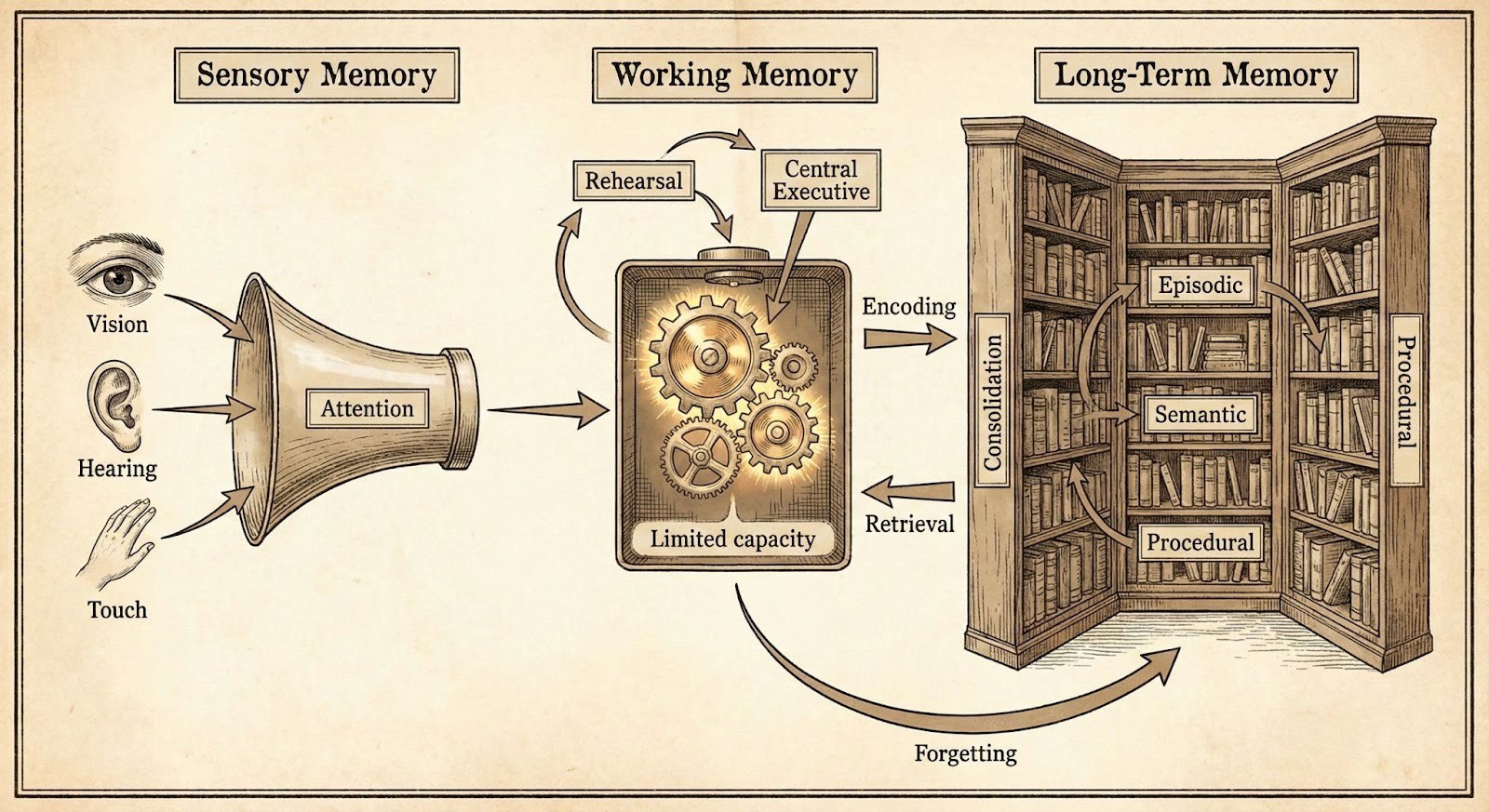
[Diagram: Human Memory System Schematic - Sensory / Working / Long-Term Memory]
Memory Dimension | AI Architecture Mapping | Core Function & Business Value |
|---|---|---|
Working Memory | LLM Context Window | Processes current tasks, keeps information active; released once the task ends. |
Episodic Memory | Structured Logs / Scenes | Records specific experiences, stories, and timelines; used to reconstruct the causal chain of business decisions. |
Semantic Memory | Knowledge Graph (KG) / World Model | Stores facts, concepts, rules, and common sense; forms the enterprise’s proprietary knowledge base and industry insights. |
Procedural Memory | Skill Components / Actions | Stores skills and operational intuition; enables AI to execute complex automated workflows. |
The core mission of a long-term memory system is to facilitate the transformation from “Fluid Intelligence” (instant reasoning) to “Crystallized Intelligence” (accumulated experience). It bridges time and intelligence, enabling AI to evolve continuously through self-feedback rather than relying solely on the static weights of pre-training.
Engineering-wise, our core challenge is: How do we grant AI a low-cost, high-efficiency, and self-evolving “Long-term Memory System”? This system must possess the fundamental components of human memory while aligning with the evolutionary trends of next-generation, LLM-based AI systems.
2. Tanka in Practice: Milestones and Real-World Validation of EverMemOS 1.0
We have completed the core architectural design of EverMemOS 1.0 and successfully deployed it as the cognitive foundation for Tanka, validating the feasibility of long-term memory in enterprise-grade scenarios.
2.1 EverMemOS 1.0 Architecture: Hierarchical Memory Organization
EverMemOS 1.0 utilizes a bionic memory organization approach, transforming raw dialogue streams into a knowledge structure that is both retrievable and comprehensible. For all incoming raw data, memory extraction is performed through the following four stages:
Semantic Segmentation: Unlike traditional fixed Token chunking, we partition data based on the semantic boundaries of original dialogue events. This ensures that each MemCell (Memory Cell) is semantically self-contained and noise-free.
Dual-Track Episode Extraction: The system generates an Episode for every memory unit, simultaneously extracting dual-track information: high-precision Atomic Facts and implicit, extended ForeSight. This design balances expressive completeness with matching precision.
Memory Scene: Using clustering algorithms, similar Episodes are merged into a Scene, effectively suppressing redundant noise during retrieval and ensuring the AI only recalls information within highly relevant contexts. This process simulates the human brain's Consolidation mechanism, sublimating scattered information into structured knowledge.
Profile Extraction: Built upon foundational memories, the system performs deep Profile extraction for individuals and groups. This includes Personal Portraits (covering identity, linguistic style, preferences, skills, and long-term goals) and Group Insights (identifying KOLs, collective objectives, and specific roles of members within the organization).
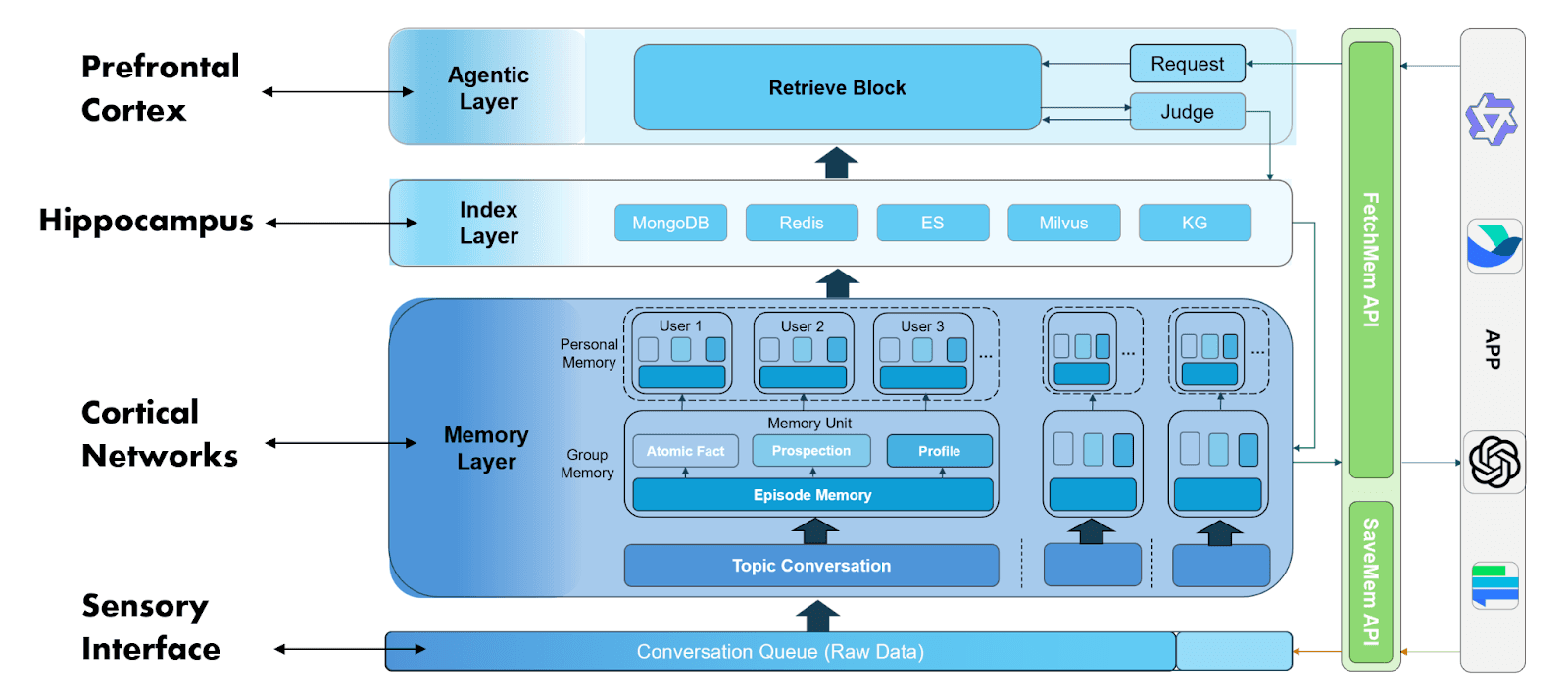
[Diagram: EverMemOS 1.0 System Architecture — The evolutionary path from raw data to high-level Profiles]
During the memory utilization phase, an agentic Layer—analogous to the prefrontal cortex—is employed to orchestrate memory retrieval and application.
2.2 Performance Evaluation
On LoCoMo, a leading industry Benchmark for long-term memory, EverMemOS achieved superior accuracy over its peers while maintaining significantly lower Token consumption.
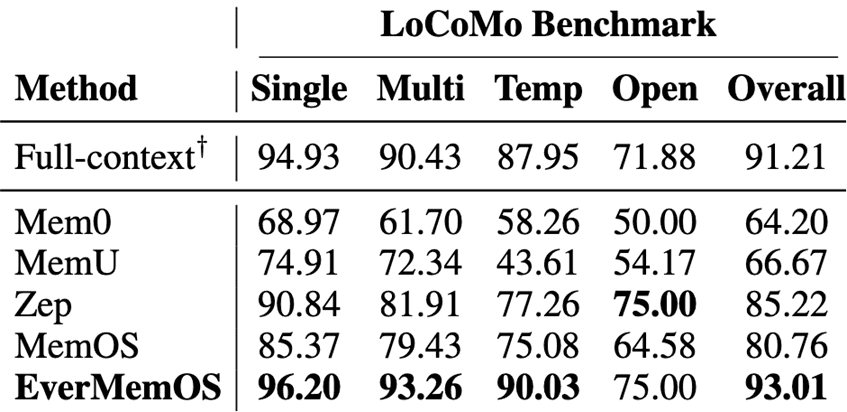
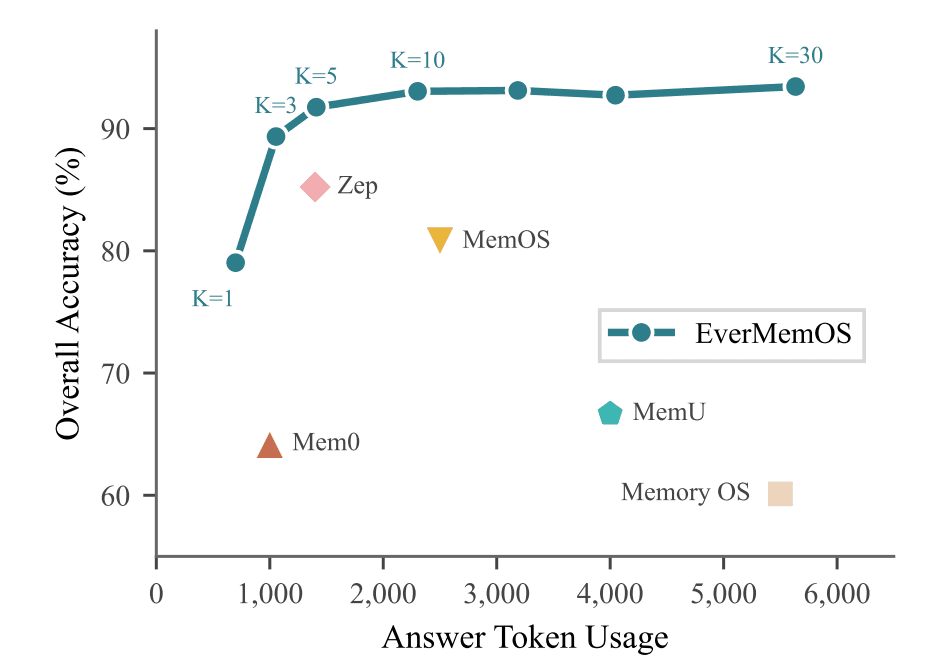
[Diagram: LoCoMo Benchmark Results — Demonstrating the high precision and low energy efficiency of EverMemOS]
Experimental data proves that EverMemOS is currently the only memory system to outperform the "LLM Full Context" model across multiple metrics, all while using only one-tenth of the average Tokens. Furthermore, EverMemOS has reached SOTA (State-of-the-Art) levels in long-term memory benchmarks such as LongMemEval, PersonaMem, and HaluMem.
2.3 Product Value: The “Cognitive Hub” of Tanka
EverMemOS 1.0 has been fully deployed within Tanka. Through Tanka Link, it ingests data from diverse sources—including Chat, Memos, Email, Google Docs, and Notion—to perform long-term memory extraction.
As of December 2025, the system has processed nearly 10 million data points spanning emails, documents, and instant messages. Various AI modules in Tanka—such as Assistant, Work, and People—leverage the shared memory maintained by EverMemOS to enhance user experience. The AI no longer generates responses based solely on the current conversation; it now provides decision support by integrating meeting summaries from months prior and understanding the user's latent preferences.
As memory systems scale and business requirements grow, we have identified several challenges where EverMemOS 1.0, despite its current leadership, must continue to evolve:
Advanced Memory Management: Enhancing support for memory deletion, privacy protection, and memory inheritance.
Cross-Application Adaptation: While semantic segmentation and foundational extraction are universal, high-level Profiles are highly context-dependent. The challenge lies in dynamically adapting to industry-specific preferences for "skills" rather than relying on rigid, pre-defined sets of 90 or 120 categories.
Feedback-Driven Evolution: Although today’s memory systems possess a degree of adaptivity, there is still a gap to be bridged before achieving full, autonomous evolution based on human-AI interaction—similar to the sophistication of modern recommendation engines.
3. Facing the Future: Building an Agentic Memory System with "Thinking Capacity" and a "Data Flywheel"
Future memory systems must transcend the role of a simple "data archive." They must become Agentic systems equipped with "thinking capacity"—not just static workflow tools for extraction, but dynamic, evolving engines that generate a user-data flywheel. To address current challenges, we are deeply exploring and restructuring the following dimensions:
3.1 Low-Level Memory Management: Balancing Security and Flexibility
To solve the challenges of memory deletion and privacy protection, we are embedding granular control mechanisms directly into the underlying architecture:
Multi-dimensional Privacy Tagging: During the memory extraction phase, the system automatically assigns privacy attributes to every generated MemCell (Memory Cell). This native tagging system allows the application side to toggle privacy filters with a single click based on specific scenarios—such as Arena competitions or internal corporate compliance—ensuring that sensitive information is never exposed within the processing chain.
Memory Inheritance and Lifecycle Management: By establishing standardized storage and persistence interfaces, we ensure that memories can span across different AI sessions and system versions. This facilitates the true management of an AI’s “Digital Legacy.”
3.2 Scene-Adaptive Distributed Profile Architecture
To resolve the variance in how different applications and organizations define Profiles, we have abandoned the rigid "fixed skill set" approach in favor of a more elastic, configuration-based solution:
Pluggable Profile Configuration: While the system extracts default portrait information, it also allows the application side to define custom portrait dimensions via independent configuration files. This enables the memory system to be deployed universally while rapidly adapting to the proprietary skill models of specific industries or companies.
RL-based Preference: Within the Memory Utilization layer, we employ Reinforcement Learning (RL) to extract latent user preferences directly from interaction Evidence. This approach allows the model to spontaneously align itself with the unique personality of a user or industry without requiring major modifications to the underlying logic.
3.3 Building a Self-Evolving Flywheel Based on Interaction Feedback
The key to making a memory system evolve as autonomously as a recommendation engine lies in shifting from a “one-way pipeline” to a “loop iteration” model:
RL-Driven Dynamic Optimization: We are building a memory system driven by Reinforcement Learning, evolving the traditional pipeline into an RL Iteration mode. By using metrics such as QA accuracy and memory hallucination rates as Reward signals, we train the system to self-align and optimize across the entire "segment-extract-use" chain.
Engineered Feedback Loops: Prior to achieving full continuous learning, we use engineered methods to support user feedback updates. The system automatically extracts high-value data from conversations (such as explicit preferences or follow-up feedback) and uses this as a weight—analogous to the "Attention" mechanism—to influence the AI's subsequent responses in real-time.
Through these explorations, we expect EverMemOS to truly break the limitations of "static data silos," evolving into a “Digital Brain” characterized by long-term consistency and deep personalization that grows alongside the user.
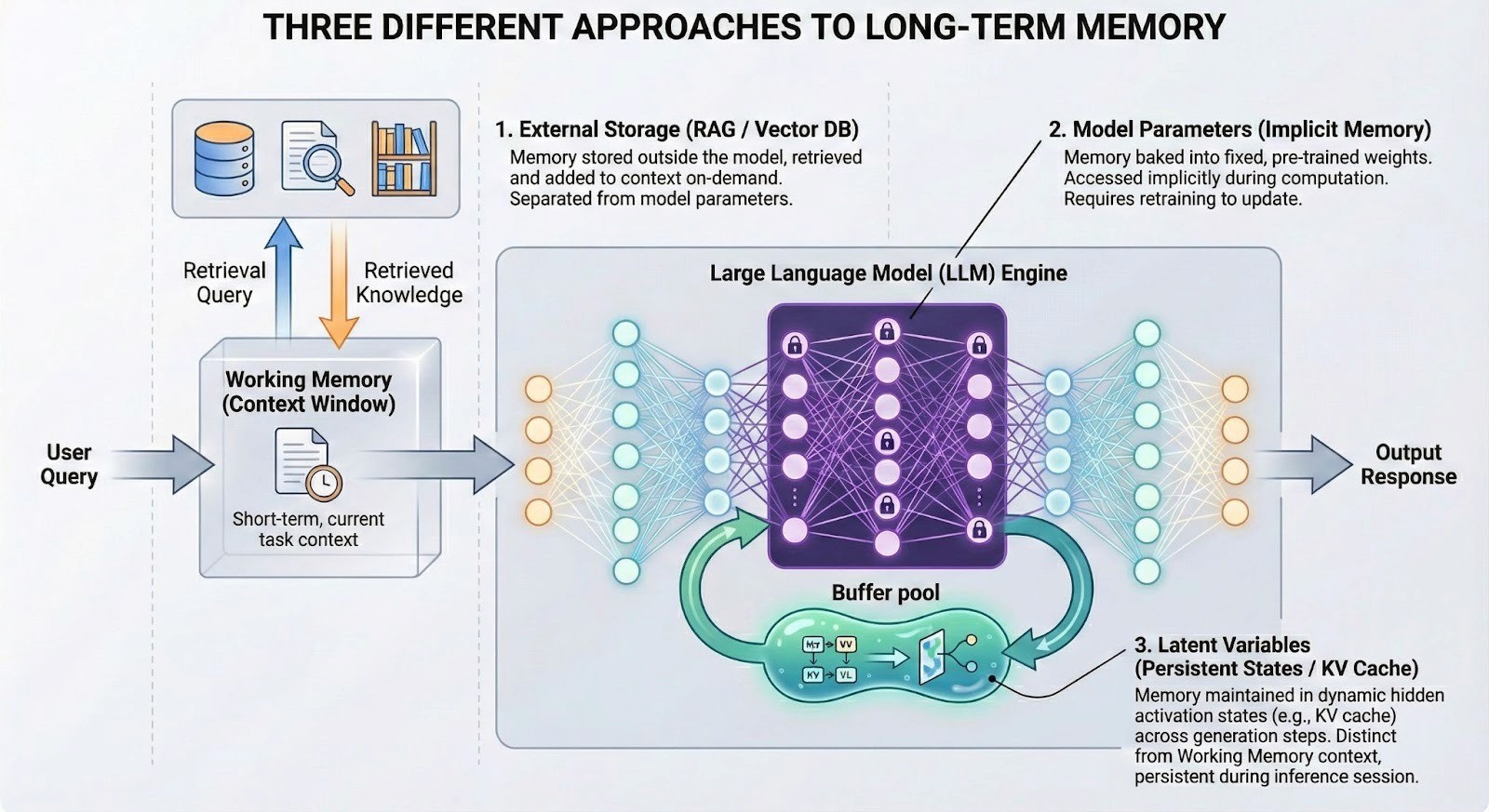
[Diagram: The Hybrid Architecture of AI Long-Term Memory — Integrating External Storage, Model Parameters, and Latent Variables]
Furthermore, to accelerate this evolution, we are developing a next-generation evaluation standard: EverMemBench. We aim to push long-term memory systems from “basic retrieval” toward “advanced cognition,” building an intelligent framework that serves as a user's “Alter Ego.” We are redefining evaluation through three dimensions:
Three-Track Parallel Architecture: This includes a massive stress test at the 300M Token scale (Track 1), a 1-on-1 dynamic update test simulating real-world information iteration (Track 2), and a complex group dynamics test evaluating multi-topic intersections and persona transfers (Track 3).
Deepened Memory Perception: Evaluation focuses not just on "fact retention," but on the system’s ability to recognize implicit causal associations between current tasks and historical information at the right moment (e.g., how a past surgery recovery should influence a current restaurant suggestion). Memory must actively drive decision-making.
Enhanced Profile Understanding: We examine the system’s ability to maintain consistent style and decision-making logic, ensuring that the AI reflects stable personality traits, risk preferences, and value orientations during complex interactions like drafting or negotiation—refusing contradictory or mediocre behavioral patterns.
4. Differentiated Advantage: What Will the Tanka of the Future Look Like?
Deeply empowered by EverMemOS, the Tanka of the future will transcend the scope of traditional collaboration tools. It is no longer just a task-processing utility but an evolving “Digital Brain,” redefining productivity moats for AI-Native enterprises through four core dimensions:
4.1 Extreme Contextual Awareness: Eliminating Information Redundancy
Tanka possesses “Long-range Memory” that breaks through session boundaries.
Historical Traceability: It remembers not just the current conversation, but the underlying logic of why a proposal was rejected three months ago.
Deep Background Perception: Users no longer need to repeat background information; the AI automatically correlates past project details and partners' specific preferences.
4.2 Behavioral Consistency under “Persona Conservation”: The Leap to Personified AI
Based on long-term memory, Tanka’s AI assistant distills a user's implicit preferences from massive interactions.
Adaptive Style: The system senses a manager's emphasis on “cost control” or a “formal tone.” When drafting a notification, the AI automatically adopts a formal style and proactively sets budgetary alerts.
Rejecting Stateless Mediocrity: This deep personalization based on historical feedback ensures behavioral continuity, evolving the AI from an “ad-hoc translator” into a “professional partner who truly knows you.”
4.3 “Personalized Biases”: Rejecting Mediocre Perfection
We believe AI’s value lies not in outputting identical, perfect templates, but in inheriting the user’s cognitive framework.
Injecting the Soul: By infusing a user’s unique biases and perspectives, every document Tanka produces carries that user’s proprietary logical soul.
Value Addition: This “imperfect yet valuable” output is the key for AI-Native enterprises to fight inefficient mediocrity and achieve differentiated competition.
4.4 Sustainable Growth of Organizational Assets: A Cognitive Firewall Against Talent Attrition
Traditional enterprises face the challenge of “cognitive loss” when key employees leave.
Experience Sedimentation: Tanka captures every bit of business reality through full-scale pipelines, sedimenting “informal processes” and “customer insights” into the enterprise’s long-term memory.
Cognitive Leap: This assetized memory allows the system to leap from being “reactive” to “predictive.” Even as team members change, the company’s “Digital Brain” continues to evolve based on accumulated cognitive assets.
Conclusion: Evolution Starts with Memory
In our AI-Native open-source logs, we are progressively advancing: from breaking the obsession with privacy (Data vs. Privacy) to ingesting every bit of business reality (Data Piping), and now, to reconstructing the AI’s cognitive hub (Memory System).
The establishment of a long-term memory system marks the moment AI finally transforms from an “instant computing machine” into a “time-aware agent.” In Tanka’s ecosystem, memory is no longer a burden of the past, but the engine of evolution.
Through EverMemOS’s bionic architecture and RL optimization strategies, we are building a cognitive foundation capable of remembering the past, understanding the present, and predicting the future. In the competition of the AI era, the ultimate winners will not be the companies with the most computing power, but those capable of most deeply sedimenting and utilizing “experience.”
We reject mediocre efficiency. We strive to ensure that every bit of business reality resonates within the AI's brain.
In our previous logs, we broke through and streamlined all data pipelines. A typical engineer would tell you the next step is Indexing—chunk the data, tag it, and store it in a vector database.
But I told my team: Stop. That’s just creating "digital corpses."
Traditional Index and Data have one fatal flaw: they are Subjectless. In a legacy database, a "sales record" is just an objective fact. It sits there in isolation, remaining exactly the same no matter who reads it.
But in an ANC (AI-Native Company), we build Memory. The fundamental difference is that memory must be tethered to a Subject to exist. Without the participation of a "Subject," data is nothing but a chaotic jumble of bytes.
Consider a single physical fact: "Everyone worked overtime last night."
For the Project Manager (Subject A), this memory is: "We’re back on track, and team morale is high."
For the New Employee (Subject B), this memory is: "The process is chaotic; I have no idea what we’re so busy with."
If Tanka simply indexed "working overtime" as an objective event, it would be a distortion. It would lose the most critical dimension: Who is experiencing it?
Therefore, we believe that "Indexing" is more than just tagging data—it’s about finding its belonging. We don't just record what happened; we record to whom it matters.
A’s Memory Cannot Become B’s Noise
Because memory is inherently subjective, the core engineering challenge in EverMemOS is not "storage," but "isolation and distillation."
"Full-scale" refers to the system; "Subjectivity" refers to the individual.
EverMind is omniscient, but as an individual, Employee A must never directly borrow Employee B's brain. This isn't just a matter of permissions; it’s a matter of cognitive logic. If A’s subjective experience were built upon B’s memories, A would suffer from a cognitive "split personality."
We aren't building a flat library; we are constructing a multi-dimensional, subject-centric Folded Universe.
The system must be able to answer: "Based on Subject A's perspective, what did that conversation just mean?"
When Data Begins to “Breathe”: The Technical Implementation of EverMemOS
To construct this “Subject-Centric Folded Universe,” we must re-engineer the cognitive architecture of AI from the ground up.
A truly AI-Native company does more than just capture data; it grants AI a human-like memory. This is not a simple, search-based “external plug-in hard drive,” but a “Digital Brain” capable of evolving over time, forging associations, and supporting complex decision-making.
Thus, we created EverMemOS—the core long-term memory system of Tanka.
1. The Problem: Why Context and Traditional RAG Fail the Soul of the AI-Native Enterprise
The current AI cognitive architecture is at a critical juncture, transitioning from “tool-based” to “agentic.” The sale of Manus illustrates that even amidst the AI Agent hype, no one has yet built a deep user-experience moat based on a data flywheel—as seen in the previous generation of search and recommendation systems. A single iteration of a foundational model or a competitor’s upgrade can easily wipe out an early mover’s advantage. The ultimate goal for all AI applications in the LLM era is to build a system that evolves autonomously based on user data.
Before diving into the architecture, we must clarify the exact problem a memory system is meant to solve in an AI-Native context.
Traditional AI applications typically handle “memory” using two strategies: providing all context to the LLM as a prompt, or using a RAG architecture to feed retrieval results into the LLM. Both approaches face the challenge of “Cognitive Dissonance,” a concept borrowed from brain science:
1.1 The Cognitive Limitations of “Stateless” Architectures
In an AI-Native context, relying solely on Context and RAG is essentially simulating “long-term intelligence” through an “open-book exam.” This Stateless architecture leads to several deep-seated flaws:
1. The Physical Bottleneck of Instant Attention: Expensive and Inefficient “RAM”
Traditional solutions attempt to simulate memory by blindly expanding the Context Window. This is merely increasing instantaneous RAM (analogous to human Working Memory), not creating persistent long-term memory.
The Paradox of Cost and Latency: Expanding context leads to an exponential increase in computational overhead. When the window overflows, the AI suffers from severe “amnesia” and logical fragmentation, losing the ability to track project evolution spanning months.
The Signal-to-Noise Contradiction: As background information piles up, the limitations of the attention mechanism often cause the model to fall into the “Lost in the Middle” trap, where instruction-following and information extraction accuracy plummet.
2. The Deep Decoupling of Retrieval and Generation: “Stitched Fragments” Without a Subject
Existing RAG architectures are essentially “Search + Concatenate” mechanisms—mechanical couriers that lack the multi-dimensional memory integration of the human brain:
Absence of Semantic and Episodic Nuance: Traditional RAG cannot distinguish between Semantic Memory (facts and common sense) and Episodic Memory (sequences of events over time). Consequently, the AI fails to grasp chronological relationships, resulting in fragmented responses that lack logical depth.
Distortion of “Persona”: Because retrieval is “subjectless,” the AI cannot undergo deep personalized adjustments based on a user’s historical preferences and feedback. It acts as an ad-hoc translator rather than a professional partner with a continuous behavioral logic.
3. The Evolutionary Dead-end of Static Storage: Isolated Data Islands
Once data is stored in traditional vector databases, it becomes an isolated island, lacking the dynamic processing power of a brain:
Lack of Memory Consolidation: Traditional systems cannot abstract, compress, or update associations during interaction gaps as humans do. They lack the capacity for “reflection” and cannot uncover latent relationships through multi-turn retrieval and reasoning.
The Barrier to Self-Evolution: This static nature allows model iterations to easily erode any head-start an early mover might have. A system that cannot “self-evolve” based on user data can never build a true experience moat, nor can it carry the “Digital Soul” required by an AI-Native enterprise.
1.2 The Bionic Definition of Memory: From Storage to Active Evolution
We believe a long-term memory system should not be a mere vector database, but a dynamically evolving “Cognitive Operating System.” This perspective is rooted in the simulation of human intelligence mechanisms.
[Diagram: Human Memory System Schematic - Sensory / Working / Long-Term Memory]
Memory Dimension | AI Architecture Mapping | Core Function & Business Value |
|---|---|---|
Working Memory | LLM Context Window | Processes current tasks, keeps information active; released once the task ends. |
Episodic Memory | Structured Logs / Scenes | Records specific experiences, stories, and timelines; used to reconstruct the causal chain of business decisions. |
Semantic Memory | Knowledge Graph (KG) / World Model | Stores facts, concepts, rules, and common sense; forms the enterprise’s proprietary knowledge base and industry insights. |
Procedural Memory | Skill Components / Actions | Stores skills and operational intuition; enables AI to execute complex automated workflows. |
The core mission of a long-term memory system is to facilitate the transformation from “Fluid Intelligence” (instant reasoning) to “Crystallized Intelligence” (accumulated experience). It bridges time and intelligence, enabling AI to evolve continuously through self-feedback rather than relying solely on the static weights of pre-training.
Engineering-wise, our core challenge is: How do we grant AI a low-cost, high-efficiency, and self-evolving “Long-term Memory System”? This system must possess the fundamental components of human memory while aligning with the evolutionary trends of next-generation, LLM-based AI systems.
2. Tanka in Practice: Milestones and Real-World Validation of EverMemOS 1.0
We have completed the core architectural design of EverMemOS 1.0 and successfully deployed it as the cognitive foundation for Tanka, validating the feasibility of long-term memory in enterprise-grade scenarios.
2.1 EverMemOS 1.0 Architecture: Hierarchical Memory Organization
EverMemOS 1.0 utilizes a bionic memory organization approach, transforming raw dialogue streams into a knowledge structure that is both retrievable and comprehensible. For all incoming raw data, memory extraction is performed through the following four stages:
Semantic Segmentation: Unlike traditional fixed Token chunking, we partition data based on the semantic boundaries of original dialogue events. This ensures that each MemCell (Memory Cell) is semantically self-contained and noise-free.
Dual-Track Episode Extraction: The system generates an Episode for every memory unit, simultaneously extracting dual-track information: high-precision Atomic Facts and implicit, extended ForeSight. This design balances expressive completeness with matching precision.
Memory Scene: Using clustering algorithms, similar Episodes are merged into a Scene, effectively suppressing redundant noise during retrieval and ensuring the AI only recalls information within highly relevant contexts. This process simulates the human brain's Consolidation mechanism, sublimating scattered information into structured knowledge.
Profile Extraction: Built upon foundational memories, the system performs deep Profile extraction for individuals and groups. This includes Personal Portraits (covering identity, linguistic style, preferences, skills, and long-term goals) and Group Insights (identifying KOLs, collective objectives, and specific roles of members within the organization).
[Diagram: EverMemOS 1.0 System Architecture — The evolutionary path from raw data to high-level Profiles]
During the memory utilization phase, an agentic Layer—analogous to the prefrontal cortex—is employed to orchestrate memory retrieval and application.
2.2 Performance Evaluation
On LoCoMo, a leading industry Benchmark for long-term memory, EverMemOS achieved superior accuracy over its peers while maintaining significantly lower Token consumption.
[Diagram: LoCoMo Benchmark Results — Demonstrating the high precision and low energy efficiency of EverMemOS]
Experimental data proves that EverMemOS is currently the only memory system to outperform the "LLM Full Context" model across multiple metrics, all while using only one-tenth of the average Tokens. Furthermore, EverMemOS has reached SOTA (State-of-the-Art) levels in long-term memory benchmarks such as LongMemEval, PersonaMem, and HaluMem.
2.3 Product Value: The “Cognitive Hub” of Tanka
EverMemOS 1.0 has been fully deployed within Tanka. Through Tanka Link, it ingests data from diverse sources—including Chat, Memos, Email, Google Docs, and Notion—to perform long-term memory extraction.
As of December 2025, the system has processed nearly 10 million data points spanning emails, documents, and instant messages. Various AI modules in Tanka—such as Assistant, Work, and People—leverage the shared memory maintained by EverMemOS to enhance user experience. The AI no longer generates responses based solely on the current conversation; it now provides decision support by integrating meeting summaries from months prior and understanding the user's latent preferences.
As memory systems scale and business requirements grow, we have identified several challenges where EverMemOS 1.0, despite its current leadership, must continue to evolve:
Advanced Memory Management: Enhancing support for memory deletion, privacy protection, and memory inheritance.
Cross-Application Adaptation: While semantic segmentation and foundational extraction are universal, high-level Profiles are highly context-dependent. The challenge lies in dynamically adapting to industry-specific preferences for "skills" rather than relying on rigid, pre-defined sets of 90 or 120 categories.
Feedback-Driven Evolution: Although today’s memory systems possess a degree of adaptivity, there is still a gap to be bridged before achieving full, autonomous evolution based on human-AI interaction—similar to the sophistication of modern recommendation engines.
3. Facing the Future: Building an Agentic Memory System with "Thinking Capacity" and a "Data Flywheel"
Future memory systems must transcend the role of a simple "data archive." They must become Agentic systems equipped with "thinking capacity"—not just static workflow tools for extraction, but dynamic, evolving engines that generate a user-data flywheel. To address current challenges, we are deeply exploring and restructuring the following dimensions:
3.1 Low-Level Memory Management: Balancing Security and Flexibility
To solve the challenges of memory deletion and privacy protection, we are embedding granular control mechanisms directly into the underlying architecture:
Multi-dimensional Privacy Tagging: During the memory extraction phase, the system automatically assigns privacy attributes to every generated MemCell (Memory Cell). This native tagging system allows the application side to toggle privacy filters with a single click based on specific scenarios—such as Arena competitions or internal corporate compliance—ensuring that sensitive information is never exposed within the processing chain.
Memory Inheritance and Lifecycle Management: By establishing standardized storage and persistence interfaces, we ensure that memories can span across different AI sessions and system versions. This facilitates the true management of an AI’s “Digital Legacy.”
3.2 Scene-Adaptive Distributed Profile Architecture
To resolve the variance in how different applications and organizations define Profiles, we have abandoned the rigid "fixed skill set" approach in favor of a more elastic, configuration-based solution:
Pluggable Profile Configuration: While the system extracts default portrait information, it also allows the application side to define custom portrait dimensions via independent configuration files. This enables the memory system to be deployed universally while rapidly adapting to the proprietary skill models of specific industries or companies.
RL-based Preference: Within the Memory Utilization layer, we employ Reinforcement Learning (RL) to extract latent user preferences directly from interaction Evidence. This approach allows the model to spontaneously align itself with the unique personality of a user or industry without requiring major modifications to the underlying logic.
3.3 Building a Self-Evolving Flywheel Based on Interaction Feedback
The key to making a memory system evolve as autonomously as a recommendation engine lies in shifting from a “one-way pipeline” to a “loop iteration” model:
RL-Driven Dynamic Optimization: We are building a memory system driven by Reinforcement Learning, evolving the traditional pipeline into an RL Iteration mode. By using metrics such as QA accuracy and memory hallucination rates as Reward signals, we train the system to self-align and optimize across the entire "segment-extract-use" chain.
Engineered Feedback Loops: Prior to achieving full continuous learning, we use engineered methods to support user feedback updates. The system automatically extracts high-value data from conversations (such as explicit preferences or follow-up feedback) and uses this as a weight—analogous to the "Attention" mechanism—to influence the AI's subsequent responses in real-time.
Through these explorations, we expect EverMemOS to truly break the limitations of "static data silos," evolving into a “Digital Brain” characterized by long-term consistency and deep personalization that grows alongside the user.
[Diagram: The Hybrid Architecture of AI Long-Term Memory — Integrating External Storage, Model Parameters, and Latent Variables]
Furthermore, to accelerate this evolution, we are developing a next-generation evaluation standard: EverMemBench. We aim to push long-term memory systems from “basic retrieval” toward “advanced cognition,” building an intelligent framework that serves as a user's “Alter Ego.” We are redefining evaluation through three dimensions:
Three-Track Parallel Architecture: This includes a massive stress test at the 300M Token scale (Track 1), a 1-on-1 dynamic update test simulating real-world information iteration (Track 2), and a complex group dynamics test evaluating multi-topic intersections and persona transfers (Track 3).
Deepened Memory Perception: Evaluation focuses not just on "fact retention," but on the system’s ability to recognize implicit causal associations between current tasks and historical information at the right moment (e.g., how a past surgery recovery should influence a current restaurant suggestion). Memory must actively drive decision-making.
Enhanced Profile Understanding: We examine the system’s ability to maintain consistent style and decision-making logic, ensuring that the AI reflects stable personality traits, risk preferences, and value orientations during complex interactions like drafting or negotiation—refusing contradictory or mediocre behavioral patterns.
4. Differentiated Advantage: What Will the Tanka of the Future Look Like?
Deeply empowered by EverMemOS, the Tanka of the future will transcend the scope of traditional collaboration tools. It is no longer just a task-processing utility but an evolving “Digital Brain,” redefining productivity moats for AI-Native enterprises through four core dimensions:
4.1 Extreme Contextual Awareness: Eliminating Information Redundancy
Tanka possesses “Long-range Memory” that breaks through session boundaries.
Historical Traceability: It remembers not just the current conversation, but the underlying logic of why a proposal was rejected three months ago.
Deep Background Perception: Users no longer need to repeat background information; the AI automatically correlates past project details and partners' specific preferences.
4.2 Behavioral Consistency under “Persona Conservation”: The Leap to Personified AI
Based on long-term memory, Tanka’s AI assistant distills a user's implicit preferences from massive interactions.
Adaptive Style: The system senses a manager's emphasis on “cost control” or a “formal tone.” When drafting a notification, the AI automatically adopts a formal style and proactively sets budgetary alerts.
Rejecting Stateless Mediocrity: This deep personalization based on historical feedback ensures behavioral continuity, evolving the AI from an “ad-hoc translator” into a “professional partner who truly knows you.”
4.3 “Personalized Biases”: Rejecting Mediocre Perfection
We believe AI’s value lies not in outputting identical, perfect templates, but in inheriting the user’s cognitive framework.
Injecting the Soul: By infusing a user’s unique biases and perspectives, every document Tanka produces carries that user’s proprietary logical soul.
Value Addition: This “imperfect yet valuable” output is the key for AI-Native enterprises to fight inefficient mediocrity and achieve differentiated competition.
4.4 Sustainable Growth of Organizational Assets: A Cognitive Firewall Against Talent Attrition
Traditional enterprises face the challenge of “cognitive loss” when key employees leave.
Experience Sedimentation: Tanka captures every bit of business reality through full-scale pipelines, sedimenting “informal processes” and “customer insights” into the enterprise’s long-term memory.
Cognitive Leap: This assetized memory allows the system to leap from being “reactive” to “predictive.” Even as team members change, the company’s “Digital Brain” continues to evolve based on accumulated cognitive assets.
Conclusion: Evolution Starts with Memory
In our AI-Native open-source logs, we are progressively advancing: from breaking the obsession with privacy (Data vs. Privacy) to ingesting every bit of business reality (Data Piping), and now, to reconstructing the AI’s cognitive hub (Memory System).
The establishment of a long-term memory system marks the moment AI finally transforms from an “instant computing machine” into a “time-aware agent.” In Tanka’s ecosystem, memory is no longer a burden of the past, but the engine of evolution.
Through EverMemOS’s bionic architecture and RL optimization strategies, we are building a cognitive foundation capable of remembering the past, understanding the present, and predicting the future. In the competition of the AI era, the ultimate winners will not be the companies with the most computing power, but those capable of most deeply sedimenting and utilizing “experience.”
We reject mediocre efficiency. We strive to ensure that every bit of business reality resonates within the AI's brain.
Tianqiao Chen, founder of Shanda Group and Chen Institute, is a visionary leader in AI for Science, dedicated to bridging the gap between neuroscience and silicon intelligence. Through Chennative.ai, he champions "Discoverative Intelligence"—advocating for AI that uncovers scientific truths rather than merely generating content. His latest manifesto, "I Choose, I Shoulder, Therefore I Am," redefines the human-AI relationship, arguing that humanity's unique capacity to bear consequences constitutes our ultimate value and defense in an era of absolute machine rationality.

Written by Yafeng Deng
VP of Shanda Group & CEO of EverMind
Yafeng Deng, VP of Shanda Group & CEO of EverMind. Graduated from Tsinghua University with over 20 years of expertise in AI algorithm and product R&D. He leads the mission to build the next generation of AI infrastructure through a world-class, open-source memory operating system that transforms stateless AI into intelligent agents that remember, learn, and evolve. Honored as one of the "2021 Top 10 AI Influential Figures of the Year in China," his leadership has consistently driven teams to top-tier results in global AI evaluations. A prolific inventor and researcher, he has filed over 160 invention patents and published more than 50 academic papers, including 10 in Nature sub-journals.


