

TANKA • 02
1. The "Desperate Calculation" Starting from a Spreadsheet
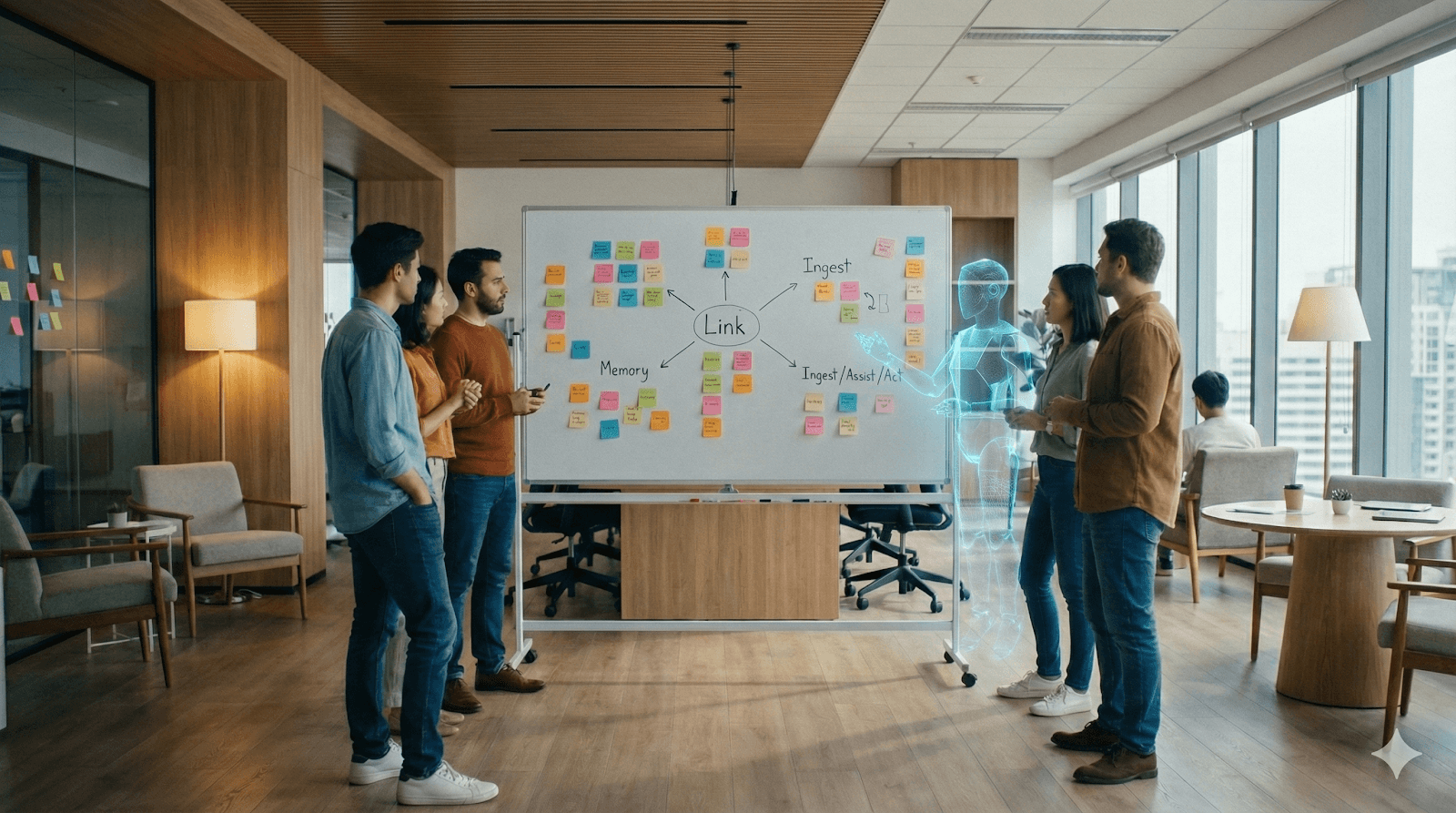
The story begins with a spreadsheet dropped into our Slack channel: "Company Paid Software List." Notion, Slack, Zoom, Linear, Figma, Midjourney, Cursor... The stats showed we were paying for 86 different SaaS tools.
In Tanka’s vision, we needed to build a comprehensive Data Pipeline (Tanka Link) to connect these isolated data islands into Tanka Memory.
Initially, the R&D team's reaction was linear: "Since there are 86, let's prioritize, research a batch, schedule a batch, and integrate them one by one."
But immediately, internal discussions overturned this logic. For Memory, it’s not a multiple-choice question of "subtraction," but a proposition of "Totality." Because you never know which fragmented bit of information will become the critical context for an AI decision in the future.
Therefore, our goal wasn't to "pick the easy ones," but to capture every bit of business reality. This instantly triggered a panic born of calculation.
2. The Deadlock: A Quagmire for Three Teams & A Soul-Searching Question
According to traditional software engineering schedules, building this "Total Pipeline" was far more complex than imagined. It involved the coordination of three R&D teams: Frontend/Backend for pipe laying, the AI team for data cleaning and extraction, and the EverMemOS team for storage and indexing.
From product research, API design, development, integration, testing to deployment, even with full effort, the cycle to integrate one App took at least a week.
A single sentence from Mr. Tianqiao Chen pierced the illusion of this linear thinking:
"One a week? So when will we ever finish?"
This wasn't just a time problem; it was an explosion of complexity. As we dove deeper into these 86 Apps, we found a massive quagmire ahead:
Uneven Interfaces: Big players like Zoom and Notion have perfect APIs; but emerging AIGC tools like Midjourney and Lovart have almost no official APIs.
Philosophical Ambiguity: Take Cursor and GitHub—is the "code" itself the business truth? Or is the Activity of the developer writing the code the memory we need? This is a cognitive issue, not just technical.
Interwoven Engineering Challenges: Incremental sync strategies, API rate limiting, complex permission mapping...
Product design (how to connect), engineering (how to stabilize), and strategy (what to connect) were tightly entangled.
In a traditional big tech company, building an Integration Platform compatible with 100+ Apps would typically require a full-time team of 10-20 people, doing grunt work day after day.
But as an AI-Native company, we absolutely could not accept this solution. The traditional "human wave" integration method is not only inefficient but an insult to technological leverage. We refuse to degrade creative work into rote manual labor.
We had to find a shortcut belonging to the AI-Native era.
3. The Breakthrough: Redefining "Piping" with AI
Facing this "deadlock," we decided to stop the blind "work" and return to the origin. We decided to use AI to launch a dimensionality reduction attack on this high-complexity problem. We didn't ask AI to write code immediately; we asked it to help us decouple.
Step 1: Cognitive Compression — Breaking the Myth of "Full Integration"
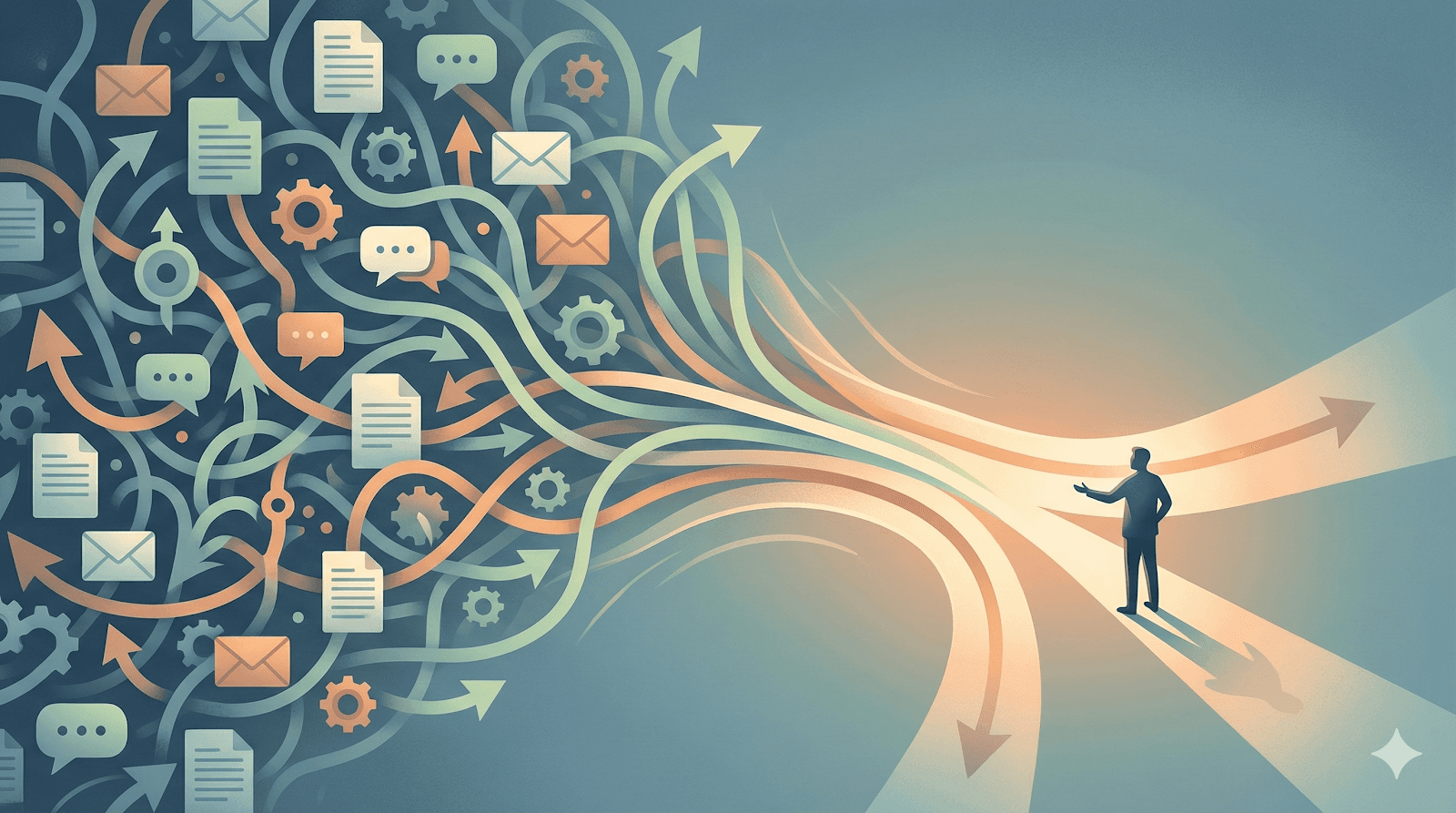
We fed the list of 86 Apps, along with our confusion (e.g., does code count as memory?), into the AI. We asked the AI to jump out of the "software category" trap and redefine them based on Tanka's Business Flow.
AI helped us build a brand-new decision space, compressing the chaotic 86 objects into 3 Native Propositions, instantly clarifying what that troubling "business reality" actually was:
📥 Ingest: Only true "narrative/conclusive data" needs to enter the pipeline. e.g., documents, chat logs. This is the body of Memory.
🤝 Assist: Code tools (Cursor) don't need to be "stored"; they need to be "reverse-empowered" by Tanka Memory as context to assist generation.
⚡ Act: Those AIGC tools without APIs (Midjourney) shouldn't be hard-scraped; they should be "driven" by Agents.
This step dismantled the massive engineering problem of "how to connect 86 Apps" into 3 completely different tactical actions.
Step 2: Ruthless Denoising from a Data Perspective
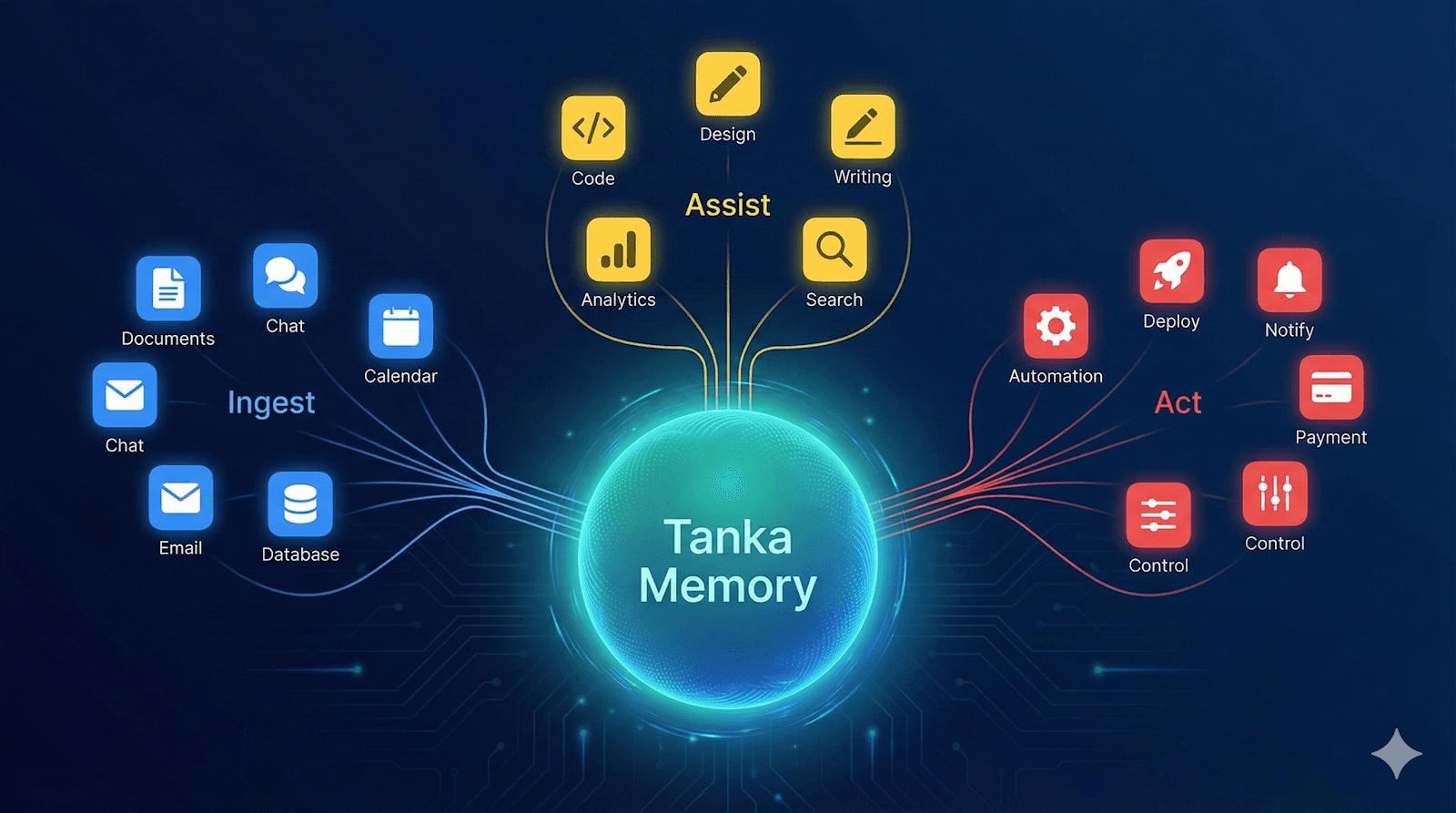
Based on this model, AI scanned the list again. The conclusion drastically reduced the pipeline load:
Only 14 truly needed the complex Ingest flow.
36 were suitable for Assist.
27 were suitable for Agent-driven Act.
The nightmare of "one a week" vanished instantly. We discovered that most software simply didn't need to go through that heaviest "integration development chain." We preserved the goal of "Total Coverage" but drastically reduced the engineering radius.
Step 3: Leaping from Decision to Protocol
After AI helped clarify the chaotic logic, the team's energy shifted from "writing code" back to "making judgments." Issues that would have caused endless debate in "Requirements Review Meetings" turned into efficient "Human-Machine Alignment." Once humans made the call, AI directly translated decisions into engineering protocols: unified data cleaning Schemas, standard interfaces for Context injection.
The complex collaboration wall between the three teams (Frontend/Backend, AI, OS) was breached by this unified protocol.
4. Deep Water Combat: When APIs Don't Exist
AI helped us clarify strategic classification (Ingest/Assist/Act), but in the deep waters of engineering implementation, we still faced the thorniest challenge: What do we do when "Business Reality" is locked in walled gardens, or APIs simply don't exist?
For the integrity of data, we had to show our "Hacker" side.
1. Breaching the "High Wall": The Grey Area Breakout of X (Twitter) & LinkedIn
For platforms like X and LinkedIn, official APIs are prohibitively expensive and heavily restricted (e.g., no access to DMs). But for Tanka Memory, a DM containing business secrets is as valuable as an email. We could not abandon this memory just because of API arrogance.
To capture this "Business Reality," we adopted more radical technical means. We bypassed the restricted official interfaces, using Headless Browser technology (like Puppeteer/Playwright) to simulate user behavior. Under compliance premises, we built a "Visual Layer Pipeline" to "see" and "save" feeds and DMs just like a human. This is not for hacking; it is for Data Sovereignty. In the AI-Native era, if the platform doesn't give you a ladder, you build a plane.
2. The "Reverse Capture" of Midjourney
In our classification, Midjourney belongs to "Act"—we drive it to draw via Agents. But here's the problem: the generated images are also important company Assets. If not saved, they drown in the Discord message stream.
Midjourney has no official API. How do we do "Memory Reflow"? We implemented a "Reverse Capture" strategy: We deployed a Discord Bot as a "Lurker" to listen to Midjourney's callbacks in real-time. Once an image is generated, the Bot immediately intercepts the image stream, automatically dumps it to an S3 bucket, and extracts the Prompt as metadata for indexing.
5. Methodology: Reconstructing R&D — From "Linear Relay" to "Cognitive Compression"
Stepping out of the specific Tanka Link project, let’s look at what has fundamentally changed in product R&D in the AI era.
At Tanka, we summarize this change as a new workflow. It is no longer the traditional "Requirements → Documentation → Development" linear relay, but a high-frequency closed loop of "Compressed Cognition → Human Decision → Immediate Execution."
You can break it down into 6 continuous but highly compressed stages. This is not just our day; it is the standard timeline for future software engineering:
Reality Input
  ↓
AI Cognitive Compression
  ↓
Structured Decision Space
  ↓
Human Key Trade-offs
  ↓
Engineering Executable Plan
  ↓
R&D Execution (Same Day)
Step 1: Humans Define "Problem Boundaries," Not "Solutions"
This is the start button. Humans remain irreplaceable, but the duty has shifted. We no longer rush to give "How," but focus on "What we want" and "What we fear":
Clear Goal: "We want to ingest content data into Memory, but never touch user behavioral data."
Clear Constraints: Where is the compliance baseline? How to manage organizational permissions?
Clear Standards: Output must guide engineering implementation, not just be pretty analysis fluff.
👉 In this stage, humans do only one thing: clarify the problem, don't rush the answer.
Step 2: AI Completes the First "Cognitive Compression"
Once humans define the boundaries, AI begins the heaviest "reading comprehension" work. Facing 86 lines of chaotic software lists, AI automatically completes denoising, classification, and abstraction. It outputs not simple suggestions, but a compressed world model: From scattered "86 Tools" → Ordered "3 Action Models."
Step 3: AI Builds "Decision Space," Not "Direct Conclusions"
This is the most easily misused step, but also AI's most powerful aspect. AI did not arbitrarily say "You should do this," but helped us build a Decision Space for discussion: It listed the three paths of Ingest / Assist / Act; It placed each tool in a candidate position, attached with reasoning hypotheses. By this step, humans are no longer facing chaotic noise, but clear options.
Step 4: Humans Make "Non-Outsourceable Trade-offs"
This is the "Human Moment" AI can never replace. Our job is not to fix AI's copy, but to repeatedly interrogate our souls:
"If we can only do half today, which half do we cut?"
"Which data, if NOT connected, is actually being responsible to the user?"
"Which capabilities, if missing, make Tanka Link lose its soul?"
Here, it is no longer calculation, but Responsibility, Judgment, and Shouldering of Long-term Consequences.
👉 This is the true value point of humanity in the AI era.
Step 5: AI Translates "Trade-offs" into "Engineering Language"
Once humans make the call, AI re-enters high-efficiency execution mode. It rapidly expands strategic "trade-offs" into engineering "structures": access scope, minimum field sets, isolation assumptions, milestone breakdowns. The essence of this step is: Lossless translation of "Strategic Judgment" into "Executable Code."
Step 6: Engineering Team Enters Execution (Same Day)
When this step begins, there is no longer any wrangling about "whether to do it." The engineering team receives direct interface definitions, event stream breakdowns, and Schema designs. AI completes its mission before the day ends, and the world is smoothly handed back to engineering.
Epilogue: The Essence of AI Native
Why is this workflow revolutionary?
❌ Old Model (Linear Inefficiency): Humans must think from 0 to 1 → Painfully write docs → Meetings to try to make others understand → Information decays in transmission.
✅ New Model (Liquid Efficiency): AI instantly completes cognitive compression from 0 → 0.6 → Humans only responsible for the key judgment from 0.6 → 1 → Immediate execution.
At Tanka, we don't use "human waves" because we don't need humans to process that first 60% of information noise. AI in front, handling complexity; Humans in back, guarding the gate.
This is our confidence as an AI-Native company to reject rote work and mediocre efficiency.
1. The "Desperate Calculation" Starting from a Spreadsheet
The story begins with a spreadsheet dropped into our Slack channel: "Company Paid Software List." Notion, Slack, Zoom, Linear, Figma, Midjourney, Cursor... The stats showed we were paying for 86 different SaaS tools.
In Tanka’s vision, we needed to build a comprehensive Data Pipeline (Tanka Link) to connect these isolated data islands into Tanka Memory.
Initially, the R&D team's reaction was linear: "Since there are 86, let's prioritize, research a batch, schedule a batch, and integrate them one by one."
But immediately, internal discussions overturned this logic. For Memory, it’s not a multiple-choice question of "subtraction," but a proposition of "Totality." Because you never know which fragmented bit of information will become the critical context for an AI decision in the future.
Therefore, our goal wasn't to "pick the easy ones," but to capture every bit of business reality. This instantly triggered a panic born of calculation.
2. The Deadlock: A Quagmire for Three Teams & A Soul-Searching Question
According to traditional software engineering schedules, building this "Total Pipeline" was far more complex than imagined. It involved the coordination of three R&D teams: Frontend/Backend for pipe laying, the AI team for data cleaning and extraction, and the EverMemOS team for storage and indexing.
From product research, API design, development, integration, testing to deployment, even with full effort, the cycle to integrate one App took at least a week.
A single sentence from Mr. Tianqiao Chen pierced the illusion of this linear thinking:
"One a week? So when will we ever finish?"
This wasn't just a time problem; it was an explosion of complexity. As we dove deeper into these 86 Apps, we found a massive quagmire ahead:
Uneven Interfaces: Big players like Zoom and Notion have perfect APIs; but emerging AIGC tools like Midjourney and Lovart have almost no official APIs.
Philosophical Ambiguity: Take Cursor and GitHub—is the "code" itself the business truth? Or is the Activity of the developer writing the code the memory we need? This is a cognitive issue, not just technical.
Interwoven Engineering Challenges: Incremental sync strategies, API rate limiting, complex permission mapping...
Product design (how to connect), engineering (how to stabilize), and strategy (what to connect) were tightly entangled.
In a traditional big tech company, building an Integration Platform compatible with 100+ Apps would typically require a full-time team of 10-20 people, doing grunt work day after day.
But as an AI-Native company, we absolutely could not accept this solution. The traditional "human wave" integration method is not only inefficient but an insult to technological leverage. We refuse to degrade creative work into rote manual labor.
We had to find a shortcut belonging to the AI-Native era.
3. The Breakthrough: Redefining "Piping" with AI
Facing this "deadlock," we decided to stop the blind "work" and return to the origin. We decided to use AI to launch a dimensionality reduction attack on this high-complexity problem. We didn't ask AI to write code immediately; we asked it to help us decouple.
Step 1: Cognitive Compression — Breaking the Myth of "Full Integration"
We fed the list of 86 Apps, along with our confusion (e.g., does code count as memory?), into the AI. We asked the AI to jump out of the "software category" trap and redefine them based on Tanka's Business Flow.
AI helped us build a brand-new decision space, compressing the chaotic 86 objects into 3 Native Propositions, instantly clarifying what that troubling "business reality" actually was:
📥 Ingest: Only true "narrative/conclusive data" needs to enter the pipeline. e.g., documents, chat logs. This is the body of Memory.
🤝 Assist: Code tools (Cursor) don't need to be "stored"; they need to be "reverse-empowered" by Tanka Memory as context to assist generation.
⚡ Act: Those AIGC tools without APIs (Midjourney) shouldn't be hard-scraped; they should be "driven" by Agents.
This step dismantled the massive engineering problem of "how to connect 86 Apps" into 3 completely different tactical actions.
Step 2: Ruthless Denoising from a Data Perspective
Based on this model, AI scanned the list again. The conclusion drastically reduced the pipeline load:
Only 14 truly needed the complex Ingest flow.
36 were suitable for Assist.
27 were suitable for Agent-driven Act.
The nightmare of "one a week" vanished instantly. We discovered that most software simply didn't need to go through that heaviest "integration development chain." We preserved the goal of "Total Coverage" but drastically reduced the engineering radius.
Step 3: Leaping from Decision to Protocol
After AI helped clarify the chaotic logic, the team's energy shifted from "writing code" back to "making judgments." Issues that would have caused endless debate in "Requirements Review Meetings" turned into efficient "Human-Machine Alignment." Once humans made the call, AI directly translated decisions into engineering protocols: unified data cleaning Schemas, standard interfaces for Context injection.
The complex collaboration wall between the three teams (Frontend/Backend, AI, OS) was breached by this unified protocol.
4. Deep Water Combat: When APIs Don't Exist
AI helped us clarify strategic classification (Ingest/Assist/Act), but in the deep waters of engineering implementation, we still faced the thorniest challenge: What do we do when "Business Reality" is locked in walled gardens, or APIs simply don't exist?
For the integrity of data, we had to show our "Hacker" side.
1. Breaching the "High Wall": The Grey Area Breakout of X (Twitter) & LinkedIn
For platforms like X and LinkedIn, official APIs are prohibitively expensive and heavily restricted (e.g., no access to DMs). But for Tanka Memory, a DM containing business secrets is as valuable as an email. We could not abandon this memory just because of API arrogance.
To capture this "Business Reality," we adopted more radical technical means. We bypassed the restricted official interfaces, using Headless Browser technology (like Puppeteer/Playwright) to simulate user behavior. Under compliance premises, we built a "Visual Layer Pipeline" to "see" and "save" feeds and DMs just like a human. This is not for hacking; it is for Data Sovereignty. In the AI-Native era, if the platform doesn't give you a ladder, you build a plane.
2. The "Reverse Capture" of Midjourney
In our classification, Midjourney belongs to "Act"—we drive it to draw via Agents. But here's the problem: the generated images are also important company Assets. If not saved, they drown in the Discord message stream.
Midjourney has no official API. How do we do "Memory Reflow"? We implemented a "Reverse Capture" strategy: We deployed a Discord Bot as a "Lurker" to listen to Midjourney's callbacks in real-time. Once an image is generated, the Bot immediately intercepts the image stream, automatically dumps it to an S3 bucket, and extracts the Prompt as metadata for indexing.
5. Methodology: Reconstructing R&D — From "Linear Relay" to "Cognitive Compression"
Stepping out of the specific Tanka Link project, let’s look at what has fundamentally changed in product R&D in the AI era.
At Tanka, we summarize this change as a new workflow. It is no longer the traditional "Requirements → Documentation → Development" linear relay, but a high-frequency closed loop of "Compressed Cognition → Human Decision → Immediate Execution."
You can break it down into 6 continuous but highly compressed stages. This is not just our day; it is the standard timeline for future software engineering:
Reality Input
  ↓
AI Cognitive Compression
  ↓
Structured Decision Space
  ↓
Human Key Trade-offs
  ↓
Engineering Executable Plan
  ↓
R&D Execution (Same Day)
Step 1: Humans Define "Problem Boundaries," Not "Solutions"
This is the start button. Humans remain irreplaceable, but the duty has shifted. We no longer rush to give "How," but focus on "What we want" and "What we fear":
Clear Goal: "We want to ingest content data into Memory, but never touch user behavioral data."
Clear Constraints: Where is the compliance baseline? How to manage organizational permissions?
Clear Standards: Output must guide engineering implementation, not just be pretty analysis fluff.
👉 In this stage, humans do only one thing: clarify the problem, don't rush the answer.
Step 2: AI Completes the First "Cognitive Compression"
Once humans define the boundaries, AI begins the heaviest "reading comprehension" work. Facing 86 lines of chaotic software lists, AI automatically completes denoising, classification, and abstraction. It outputs not simple suggestions, but a compressed world model: From scattered "86 Tools" → Ordered "3 Action Models."
Step 3: AI Builds "Decision Space," Not "Direct Conclusions"
This is the most easily misused step, but also AI's most powerful aspect. AI did not arbitrarily say "You should do this," but helped us build a Decision Space for discussion: It listed the three paths of Ingest / Assist / Act; It placed each tool in a candidate position, attached with reasoning hypotheses. By this step, humans are no longer facing chaotic noise, but clear options.
Step 4: Humans Make "Non-Outsourceable Trade-offs"
This is the "Human Moment" AI can never replace. Our job is not to fix AI's copy, but to repeatedly interrogate our souls:
"If we can only do half today, which half do we cut?"
"Which data, if NOT connected, is actually being responsible to the user?"
"Which capabilities, if missing, make Tanka Link lose its soul?"
Here, it is no longer calculation, but Responsibility, Judgment, and Shouldering of Long-term Consequences.
👉 This is the true value point of humanity in the AI era.
Step 5: AI Translates "Trade-offs" into "Engineering Language"
Once humans make the call, AI re-enters high-efficiency execution mode. It rapidly expands strategic "trade-offs" into engineering "structures": access scope, minimum field sets, isolation assumptions, milestone breakdowns. The essence of this step is: Lossless translation of "Strategic Judgment" into "Executable Code."
Step 6: Engineering Team Enters Execution (Same Day)
When this step begins, there is no longer any wrangling about "whether to do it." The engineering team receives direct interface definitions, event stream breakdowns, and Schema designs. AI completes its mission before the day ends, and the world is smoothly handed back to engineering.
Epilogue: The Essence of AI Native
Why is this workflow revolutionary?
❌ Old Model (Linear Inefficiency): Humans must think from 0 to 1 → Painfully write docs → Meetings to try to make others understand → Information decays in transmission.
✅ New Model (Liquid Efficiency): AI instantly completes cognitive compression from 0 → 0.6 → Humans only responsible for the key judgment from 0.6 → 1 → Immediate execution.
At Tanka, we don't use "human waves" because we don't need humans to process that first 60% of information noise. AI in front, handling complexity; Humans in back, guarding the gate.
This is our confidence as an AI-Native company to reject rote work and mediocre efficiency.

Written by Jack Wang
VP of Tanka
Jack Wang, VP of Tanka—The Operating Base for AI-Native Companies—leads the R&D of Tanka’s advanced long-term memory system for real-world work scenarios, turning everyday conversations, documents, and decisions into durable organizational intelligence. With a dual background in computer science and biology, he explores an AGI-inspired path that pairs powerful reasoning models (the “prefrontal cortex”) with robust memory architectures (the “hippocampus”), aiming to build AI that doesn’t just respond, but continuously learns, retains context, and compounds productivity over time.


